
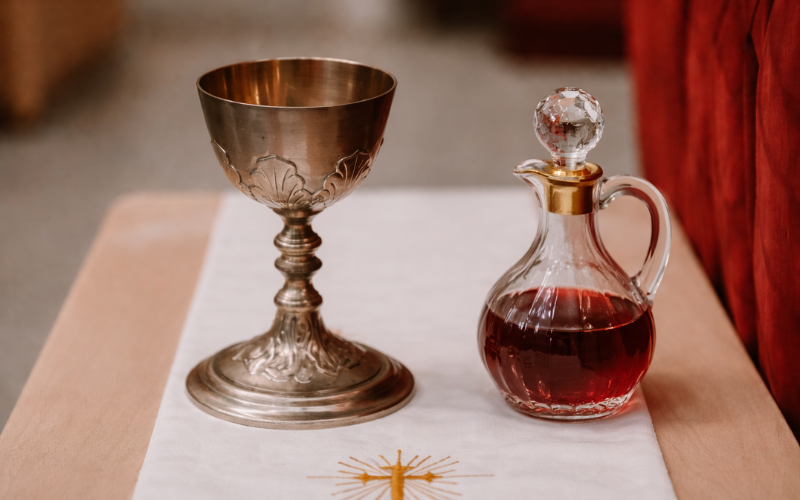
Throughout our history, wine has been present in great celebrations, both in the secular and religious spheres. In this latter environment, religions have always sacralized wine, either because it is a product typical of its place of origin, or because of its connection with power. The importance of wine is such in the religious world that it even has its own deities. The best-known examples are Osiris, God of wine for the Egyptians, Dionysus for the Greeks, and Bacchus for the Romans. However, it was the Christian religion that went one step further, granting it the status of blood of Christ.
Christianity turned everything related to oenology into an ecclesiastical parable. The vineyard represents the church, while the vines represent the parishioners, with wine being the great metaphor when equating it to the blood of Christ. The Last Supper established the Eucharist, consecrating the bread as the body of Jesus and the wine as his blood. From that moment on, this connection transcended to a spiritual plane. There is no doubt that this link influenced the extension of the vineyards and the culture of wine through the monasteries.
The appearance, in the 10th century, of the Order of Cluny, reformers of the Benedictine, and its subsequent transformation into the Cistercian Order, had a lot to do with this, when the latter founded the first abbey in Burgundy, the Abbey of Cluny. . The Cistercians spread throughout Europe, creating more than seven hundred monasteries in which the wine culture spread, which, in turn, grew as monks made pilgrimages to holy places. The passage of centuries has consolidated wine culture, developing and improving the product that we drink today.
So, today, thanks to religious culture, we can enjoy wonderful wines. The blood of Christ works the miracle of happiness, even in those who are not Christians. Amen.