
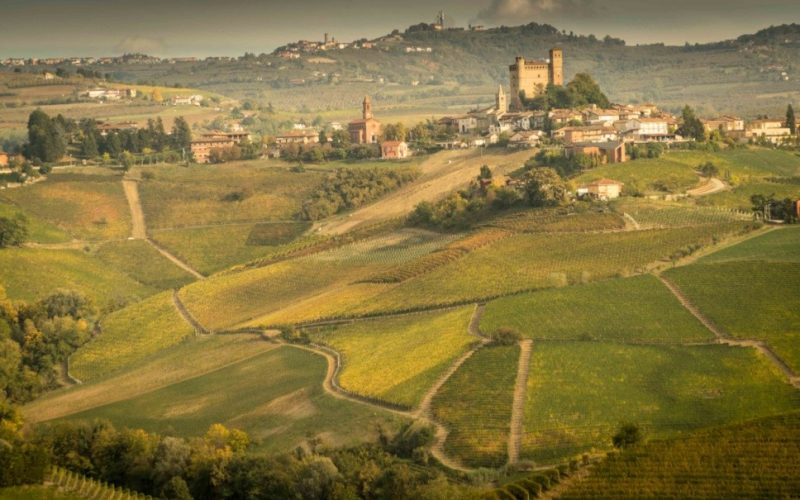
Every time I leave Piedmont I do the math looking for a date to return. In all the wine-producing areas I enjoy their wines, their landscapes and their people, but Piedmont has an I don’t know what that captivates me beyond measure. Perhaps it is its undulating green carpet, with the villages sculpted on its delicate hills, or its exquisite gastronomy, or the memories of great experiences with family and friends, or as simple as drinking barolos and barbarescos on the spot, which have me hooked from the first day. Perhaps what really seduces me is the whole of it all.
Its location, “at the foot of the mountains” – the Alps to the north and the Apennines to the south – gives its name to the second largest region in Italy, after Sicily. The mountainous relief of the land causes the vineyards to be located on steep slopes and on inclined terraces, which favors drainage and sun exposure.
In Piedmont we can differentiate five wine regions:
– The Valley of Sésia, in the north, where the D.O.C.G. of Gattinara and Ghemme.
– The Dora Baltea Valley, in the northwest, with some of the steepest vineyards in Europe, planted, especially, with the red nebbiolo variety and the white erbaluce. As producers, the towns of Carema and Canavese stand out.
– The Monferrato Hills, in the central part, produce, especially, Barbera and the sparkling wines Asti Spumante and Moscato de Asti, both based on Muscat grapes. In turn, Moferrato is subdivided:
- Monferrato Casale
- Monferrato Astigiano
- Upper Monferrato
- -Colline Torinesi
- Tortona
– Roero, south of Turin, next to Le Langhe.
– Le Langhe, south of Asti and Alba, where the D.O.C.G. Barolo and Barbaresco, the elite of Piedmont.
Although nebbiolo is the queen of Piedmont, there are also other grape varieties, red and white. Among the first: Nebbiolo, Barbera, Dolcetto, Pelaverga, Freisa, Grignolino, Ruchè and in white: Moscato Bianco, Cortese, Nascetta, Arneis, Erbaluce. Many of these varieties are unknown to the general public, largely due to the presence of the almighty nebbiolo, but they produce very interesting wines.
Soon I will return to Piedmont. I count the days to see the sublime landscape offered by the viewpoint of La Morra, to walk through the cobbled streets of the town of Barolo, to enjoy a wine in the old church of the Brotherhood of San Donato, today converted into the Regional Enoteca of Barbaresco or, simply, to enjoy a barolo or a barbaresco in any of the vineyards where the bottle comes from.